Linking Science, Citizen Conservation, and Land Management to Recover the
Southeastern American Kestrel in Florida, with Speaker Dr. Kenneth Meyer
Socializing: 6:45 p.m.
Meeting starts: 7 p.m.
Program starts: 7:15 p.m.
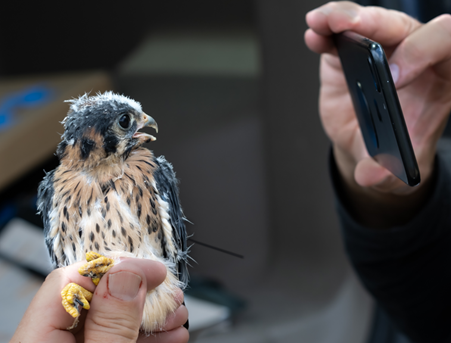
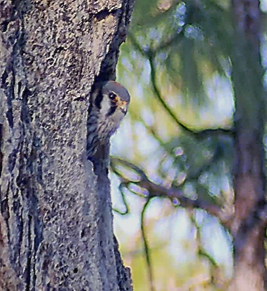
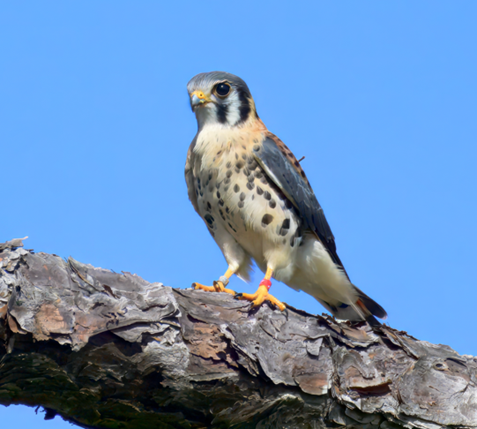
About the presentation: The American Kestrel’s preference for open habitats has made it a symbol of wildlife on rural American lands. Unfortunately, the U. S. population has declined by 82 percent since the 1970s. This includes the nonmigratory genetically distinct subspecies known as the Southeastern American Kestrel (SEAK), one of only 32 birds listed as Endangered or Threatened by Florida Fish and Wildlife. Florida harbors most of the remaining SEAK population. Since 2021, our multi-partner project has addressed questions about first-year survival rates and dispersal, home range areas, relationships between habitats and reproductive rates, predation rates, and the best nest box strategies for recovering the Florida SEAK population.
Free, open to all.
Information: tomstclair8@gmail.com or 904-303-0919.
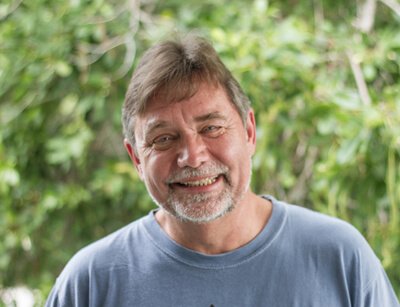
Ken Meyer
About the speaker: Ken Meyer obtained his B.S. degree in Zoology from the University of Maine, Orono, in 1977; and his Ph.D. in Zoology from the University of North Carolina, Chapel Hill, in 1987. He studied imperiled birds as a research associate with the National Park Service and UF’s Department of Wildlife Ecology and Conservation, where he has served since 1996 as a Courtesy Associate Professor. Meyer co-founded Avian Research and Conservation Institute (ARCI) in 1997, where he still works as Executive Director and Senior Research Ecologist. He and his team have studied the behavior, ecology, and management needs of 23 bird species of conservation concern in North, Central, and South America and the Caribbean Basin.